.png)
France has set ambitious renewable energy targets, yet grid connection times remain long, despite successive reforms.
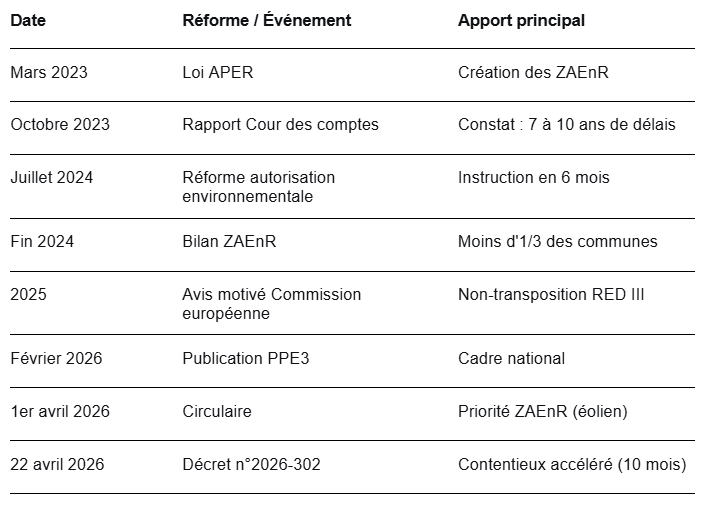
The Decree No. 2026-302 (April 22, 2026) on the simplification of environmental litigation procedures is the third procedural reform in four years, following the Renewable Energy Acceleration Act (APER) (March 2023) and the environmental authorization reform (July 2024). It establishes an accelerated litigation regime for renewable energy projects. The reason for such frequent reform is that timelines are not shrinking and that France is falling behind on its targets.
In its October 2023 report on wind power subsidies, the Court of Audit states that the average time to obtain authorization to build a wind farm, once legal challenges are cleared, is 7 years for onshore wind and 10 years for offshore wind. That is double the time of some neighboring countries! A study confirms the gap for offshore: between 4.5 years in the Netherlands and up to 11 years in France. For solar, another study highlights that lead times exceed 2 to 4 years in several European countries, including France, whereas the RED III directive sets a maximum timeframe of 1 year for projects located in acceleration zones (2 years for others).
These delays directly impact the achievement of climate goals and project competitiveness. Each year of delay represents hundreds of thousands of tons of CO₂ not avoided and billions of euros in pending investments.
They cannot be explained solely by the strictness of French environmental law (Environmental Charter, broad precautionary principle, ease of legal recourse). Three governance bottlenecks are more decisive in explaining the delays:
- administrative fragmentation : an authorization simultaneously involves prefects, DREAL, Bâtiments de France, military authorities, civil aviation, Météo France, the Biodiversity Office... with no designated coordinator or enforceable deadlines.
- regulatory instability: the implementation of each reform creates a transitional period of paralysis (the APER law implementation report noted the slow publication of the 32 decrees scheduled after its enactment).
- the lack of enforceable spatial planning upstream: the renewable energy acceleration zones (ZAEnR) created by the APER law were intended to provide developers with early visibility on favorable sites. By the end of 2024, one-third of municipalities had submitted their proposals, of which only half had been validated by the prefectures. The PPE3 (February 2026) provides the framework that was missing to give the ZAEnR their purpose. Its operational implementation was clarified by a circular (April 1, 2026): prefects must now prioritize the processing of projects located in ZAEnR and ensure deadline monitoring. However, this circular currently only covers onshore wind power.
The July 2024 reform attempted to address the first hurdle by conducting the review process and public consultation simultaneously. It aimed for a six-month review period. The April 2026 decree tackles the issue of litigation by setting fixed timeframes for court rulings (10 months).
A comparative study on the transposition of RED III highlights the lack of inter-administrative coordination, which is confirmed by thereasoned opinion sent to France by the European Commission for failure to transpose the provisions of RED III.
French authorization timelines for renewable energy are not an environmental law issue, but primarily a matter of state organization. The ongoing reform of inter-ministerial governance, modeled on the single lead authority approach used elsewhere in Europe and supported by the now-available spatial planning (PPE3), has a chance of reducing delays, provided that the April 2026 circular is extended to all sectors and local resistance is addressed.