


.png)
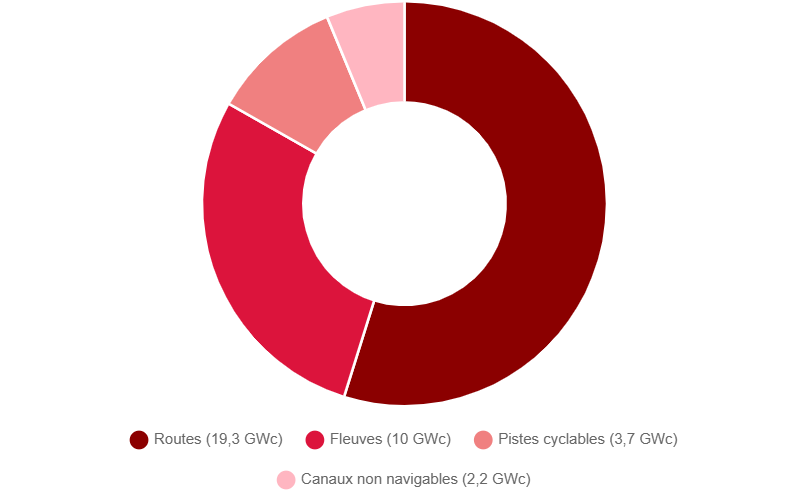
Faced with land saturation, linear photovoltaic is an innovative solution. It consists in installing solar panels along or on existing infrastructures (railways, highways, roads, bike paths, canals, etc.) rather than on surfaces (solar farms, roofs). According to The AREP-CNR study its national potential would be considerable: 35 GWp, or 38 TWh/year (8.5% of French electricity consumption). In 2024, total solar production in France was 24.5 TWh.
Distribution of the French linear photovoltaic potential
Total potential: 35 GWp • Source: AREP-CNR study, May 2025
Technological challenges
Adapting PV to the constraints of each infrastructure is complex. On railways, two philosophies are opposed: reversible systems, such as The Solveig prototype developed by AREP for SNCF, and permanent solutions, like Sun-Ways in Switzerland, which installs the PV directly between the rails. The mechanical and maintenance constraints are considerable (vibrations, expansions, shocks, etc.).
But it is electrical integration that represents the major challenge for linear solar energy. Although the injection into the public network is generally controlled, the direct supply of the rail traction network still requires developments (power electronics in particular). This innovation could transform rail infrastructures into “smart grids”, significantly reducing their dependence on the national electrical network.
Regulatory complexities
The deployment of linear photovoltaics is part of a complex regulatory landscape, at the intersection of urban planning law and different regulations (Railway, road, river...) and energy policies. The 2023 APER law is an accelerator: it explicitly encourages the installation of PV “along highways and near major infrastructures”, favors the valorization of areas that are already artificialized and paves the way for administrative simplification.
Unlike conventional ground-based photovoltaics, subject to prior declaration or building permit (> 1 MWc), linear photovoltaics involves specific procedures related to the modification of existing infrastructures, with multiple challenges (heritage, landscape, societal acceptability, etc.).
A specific regulatory framework (permits, conditions for injecting into networks, maintenance and safety responsibilities, etc.) would make it possible to remove these obstacles.
Economic models based on land
Land is the major competitive advantage of linear solar. It is revolutionizing the economic equation by valorizing spaces that were previously unproductive. In addition, it represents an opportunity for infrastructure managers to diversify revenues while contributing to their decarbonization goals.
The French potential is considerable: 30,000 km of railways, 12,000 km of motorways, thousands of km of canals and airport infrastructures.
SNCF aims for 1000 MWp of solar capacity by 2030 and includes ferrovoltaics in its global strategy. In Switzerland, Sun-Ways estimates that deployment across the entire rail network could generate 1 TWh annually.
Economy models vary by configuration. Network injection, which is technically simpler, makes it possible to benefit from guaranteed purchase rates or to sell on the market. Self-consumption (powering railway equipment, highway lighting, signalling systems) requires heavier investments.
Caderousse, French linear solar laboratory
Located on the ViaRhôna cycle route in Vaucluse, the Caderousse linear photovoltaic park, (“Ophélia” project)) is a 1 MWc demonstrator over 900 meters carried out by an industrial consortium (CNR, project owner with Nexans, Schneider Electric, SNCF and SuperGrid Institute). Commissioned this summer with an experimental phase until 2028, it aims to validate replicability on “axes of several km”.
Supported by France 2030 and ADEME, it includes a major technological innovation: its medium-voltage direct current electrical architecture (MVDC 10,000 V) which solves the challenge of energy losses over long distances. The system integrates DC electronic transformers developed by SuperGrid Institute (efficiency > 99%), Schneider Electric protective equipment that can be controlled remotely, and partially recycled MVDC Nexans cables.
Perspectives
Beyond the experiments (in France, Switzerland, germany, United States, japan...) deployment requires significant investments in R&D, the standardization of equipment and installation and maintenance procedures, and regulatory clarification.