


.png)
Waste heat is thermal energy produced by a process for which it is not the purpose and which is therefore not recovered or valued. Data centers are a source of fatal heat: depending on the cooling systems used, the heat dissipated by servers and IT equipment is evacuated in the form of hot air or hot liquid in cooling loops. This heat can be recovered using a heat exchanger that takes the calories to transfer them to another heat transfer fluid. Data center heat can thus be used by being injected into an urban heating network to heat communities, or by being transferred to a direct consumer.
In France, according to ADEME, the potential for waste heat recoverable via data centers was 1 TWh in 2020, equivalent to the heating needs of nearly 100,000 homes. In 2030, given the increase in the number of data centers and their power, this figure could increase to 3.5 TWh. The PPE 3 project also aims to value 25 to 29 TWh of waste heat in heating networks by 2035. As of October 2025, the European Energy Efficiency Directive also imposes theHeat recovery obligation for data centers with a nominal capacity of 1 MW or more, unless economically or technically not viable. In reality, this obligation is only slightly restrictive for data centers. Beyond the obligation, other European countries such as Finland or Denmark are implementing support policies to encourage data centers to valorize their waste heat.
La Recovered heat temperature range depends on the cooling system set up in the data center. Cooling systems that reject hot air return waste heat that is difficult to recover because they require an additional air/water exchanger. The cooling systems that provide the highest output temperature range are direct cooling systems such as direct to chip liquid cooling or immersion cooling (see Decrypting Zenon on this subject). The average temperature that can be recovered at the exit of the data center is around 25-45°C, but the temperature of urban heating networks is more around 70-95°C. It is therefore necessary to raise the heat temperature at the outlet of the data centers using a heat pump. Of research projects exist to raise the temperature using thermal solar panels in order to avoid additional electricity consumption.
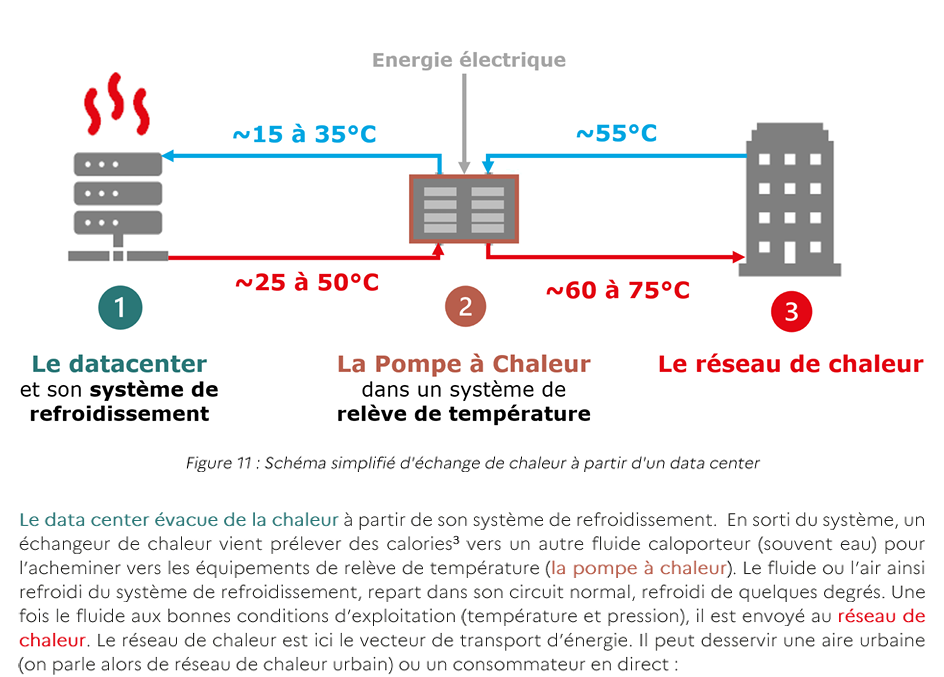
Figure: Simplified diagram for recovering waste heat from a data center (ADEME)
Data center waste heat recovery is facing technical and economic challenges :
- Heat transport: Data centers are generally located outside communities, but the heat from these infrastructures can only be used if consumers or an existing heating network are nearby. This involves planning the establishment of the data center beforehand and in synergy with local authorities and actors.
- Variability of supply and demand: Heat production by data centers is constant, but heating demand is seasonal.
- Economic viability of the model: Investments in equipment for the valorization of waste heat from data centers (heat exchanger, temperature reading system, creation of premises, heat distribution networks, exchange substation) are high and constitute a major difficulty. In France, the Heat fund from ADEME makes it possible to support such projects.
The success of the recovery of waste heat from a data center lies in the collaboration and strategic planning between: heat network operators, data center operator and local authorities. Many European countries are already experimenting with recovering waste heat from data centers, such as in Sweden where the project Stockholm Data Parks, launched in 2017 at the initiative of the city, brings together more than thirty data centers and aims to provide 10% of the heating requirement of the city by 2035. Projects also exist elsewhere such as in finland, or in france, as well as at Canada.