


Unlike "sustainable," "organic," or "integrated" farming, which are also associated with "agriculture," the term "regenerative" only makes sense in contrast to a prior state of degeneration that it presupposes without naming. The word carries an implicit diagnosis: that of soils degraded by a model it does not explicitly identify. It also carries a promise of repair, which explains its use by a wide variety of actors, including those who perpetuate that very model. Readers will also notice, throughout this analysis, the alternation between "regenerative" and "regenerating": this is not a typo, but a reflection of the inconsistency even within the French translation of the term.
Yet it is enjoying a success evidenced by its use by major industrial groups: Nestlé announced a $1.3 billion investment over five years (2021), PepsiCo is targeting 2.8 million hectares converted by 2030 (globally), Cargill 4 millionhectares over the same timeframe (on the more limited scale of North America). But none of these commitments are based on a common legal or regulatory definition.
The term "regenerative agriculture" appeared in the late 1970s, coined by Medard Gabel, before Robert Rodale gave it its first formal definition in the early 1980s: agriculture that, at increasing levels of productivity, increases its biological production base. Rodale's ambition already went beyond "sustainable" to encompass social structures, animal welfare, and the regeneration of soil and biodiversity. He aimed to extend organic farming, not to bypass it.
The concept saw an initial peak of interest in the late 1980s, then almost completely disappeared from the literature by the mid-2000s. A master's thesis from UCLouvain documents the starting point of its resurgence: on September 23, 2019, in New York, five multinationals (Danone, Nestlé, Unilever, Mars, and Yara) founded the One Planet Business for Biodiversitycoalition. Its launch press release establishes an operational definition of what it calls "regenerative agriculture": the deployment of practices that store carbon in the soil, increase its water retention capacity, and improve crop resilience. This choice addresses a concrete dependency within supply chains (only nine plant species account for 66% of global agricultural production, according to the FAO), as cited by the coalition itself, and anticipates the international regulatory framework expected at the time from the COP15 biodiversity summit. In the absence of an independent verification mechanism, this "regenerative agriculture" is vulnerable to criticism of co-optation.
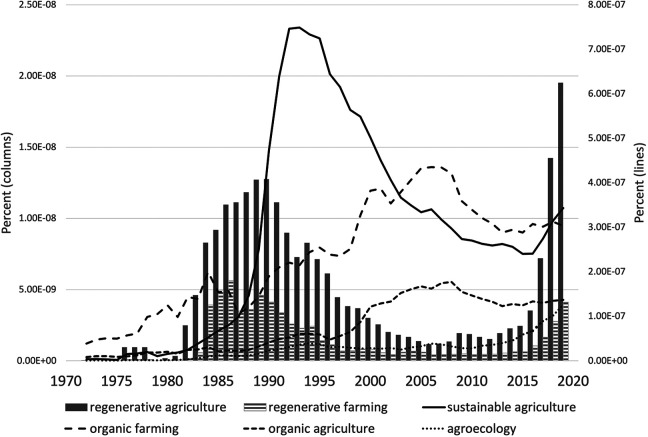
Figure 1 — Frequency of the term "regenerative agriculture" in printed literature between 1970 and 2023 (Giller et al., 2021)
A review of publications confirms the resulting bifurcation: scientific literature discusses practices (cover crops, no-till, crop-livestock integration, etc.), while the websites of economic stakeholders highlight promised results (carbon storage, fertility, biodiversity). In France, an analysis by INRAE, which compares the term with that of agroecology, reaches the same conclusion: a tenuous scientific basis and incompatible usage depending on the stakeholder. In the farming community, the term is linked to a movement challenging extractivism, rooted in traditional practices. In industrial strategies, it becomes a tool for legitimation, layering a few practices onto standard operations without restructuring production systems.
This misappropriation obscures the term's primary mission: the restoration of biodiversity, cited as an objective in the majority of scientific definitions, just ahead of carbon. An experimental site in Scotland measures 57% more earthworms and twice as many pollinators in regenerative agriculture compared to conventional systems. These organisms are not merely indicators; they are the ones that transform organic matter into stable carbon, the mechanism measured in the first installment of this series.
Regenerative agriculture is therefore not a stabilized scientific concept that has subsequently degraded or "degenerated." Its polysemy is, even to the point of paradox, constitutive of its success.