


.png)
Without distributed flexibility, the massive deployment of intermittent renewable energies creates grid constraints that hinder the transition itself. Virtual power plants (VPPs) aggregate distributed energy resources to make them act as a single power plant.
Two VPP segments can be distinguished: industrial & commercial and residential. The industrial segment dominates with 45% of global revenues, 25% for the commercial sector (offices, hospitals, universities, shopping centers), and 30% for the residential sector (which has the highest growth rate).
Different Assets, Similar Architecture
Industrial and commercial VPPs aggregate a small number of powerful assets (from several hundred kW to several MW) with predictable behavior: electric furnaces, compressors, pumping stations, large-capacity batteries, available on demand with a documented load curve. These assets are precisely those involved in industrial electrification, a central process in the decarbonization of heavy industry. Managing them as VPPs creates dual value: grid flexibility and accelerated replacement of fossil fuels.
Residential VPPs operate on the opposite principle: millions of assets (radiators, water heaters, heat pumps, home batteries, and EVs being charged), each representing a few kW. These devices are key drivers for decarbonizing various uses: heating, hot water, and mobility. Individual behaviors are unpredictable, but the aggregated behavior of hundreds of thousands of assets can be modeled.
Grid services demand very high responsiveness. Voltalis, a French operator certified by RTE, offers embedded devices that provide responsiveness under four seconds (compared to thirty seconds required from conventional power plants).
Industrial VPPs rely on programmable logic controllers, robust industrial protocols and SCADA systems integrated into production processes. Residential VPPs utilize a lightweight IoT layer, consumer protocols, and large-scale behavioral prediction algorithms. In France, the 37.3 million Linky meters form the essential measurement layer, but they do not control equipment beyond the meter. This is a limitation that Voltalis or Octopus address with their devices, and that the project Fleximax (a France 2030 laureate, supported by ADEME) explores via existing FM broadcasting infrastructure.
Complementarity Rather Than Competition
The profitability of an industrial VPP is straightforward: adjustment mechanisms, reserve markets, capacity mechanisms. The model is established and profitable.
The residential model requires a critical mass before achieving profitability. Two approaches coexist: the operator model (where the aggregator captures grid value and redistributes it as a free service, e.g., Voltalis or Octopus) and the participatory model (the prosumer is directly compensated (e.g. NEBCO in France).
The French regulatory framework remains more favorable to industrial and commercial VPPs. For the residential sector, two shortcomings hinder the decarbonization potential: the absence of a stable framework for vehicle-to-grid (V2G) and minimum thresholds that are still prohibitive in certain markets.
The RTE's 2025 forecast report introduces a key signal: with the increase in negative price periods linked to solar surplus, residential flexibility gains increasing value for absorbing photovoltaic surpluses without curtailment. This is the condition for the development of renewable energy sources (RES) to remain compatible with grid stability.
TheADEME estimates the residential potential at 15 GW technically available. A potential whose effective activation will depend as much on attractive economic models as on user trust.
The challenge is to establish the pricing, regulatory, and infrastructural conditions allowing the convergence of the two segments into mixed VPPs at the territorial level in order to make distributed assets an operational pillar of the decarbonization pathway.
Additional sources: DOE VPP Liftoff 2025 — MDPI VPP Architecture 2018
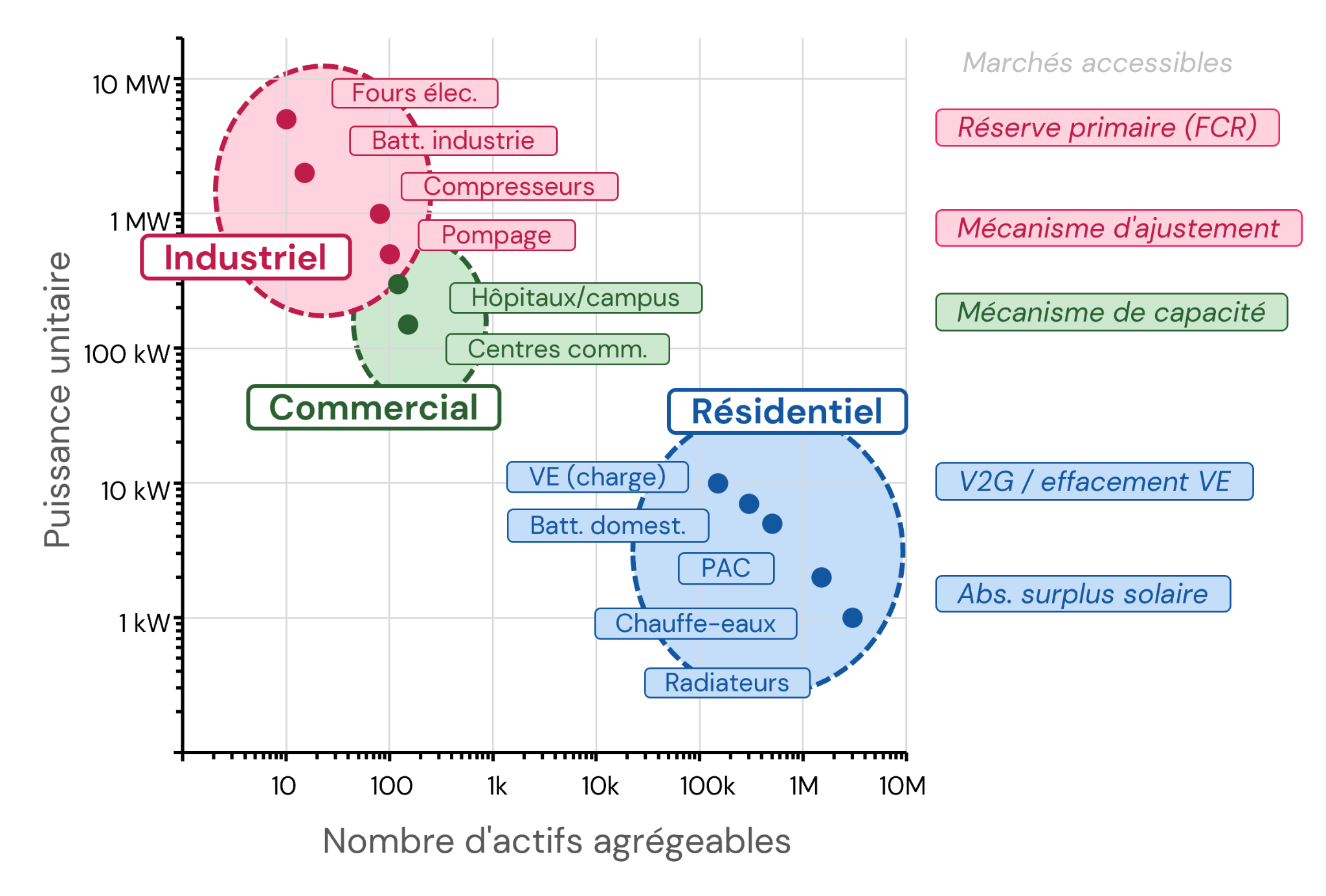
Figure - VPP: Two aggregation approaches (Mordor Intelligence 2025, ADEME 2025, RTE 2025)