


.png)
Real-time management by a VPP of hundreds of thousands of dispersed energy assets requires a stratified software architecture. This complexity is not accidental: it is the direct consequence of the energy transition. The more intermittent and distributed renewable energies advance, the more it becomes necessary to coordinate heterogeneous resources to maintain the balance of the network.
The standard architecture of a VPP platform is based on four interdependent layers: hardware (IoT and sensors), communication (protocols and networks), application (algorithmic optimization) and markets (interfaces with electricity exchanges). This separation allows modularity (an aggregator can replace its IoT boxes without rewriting its algorithms), but each layer is also a potential point of failure.
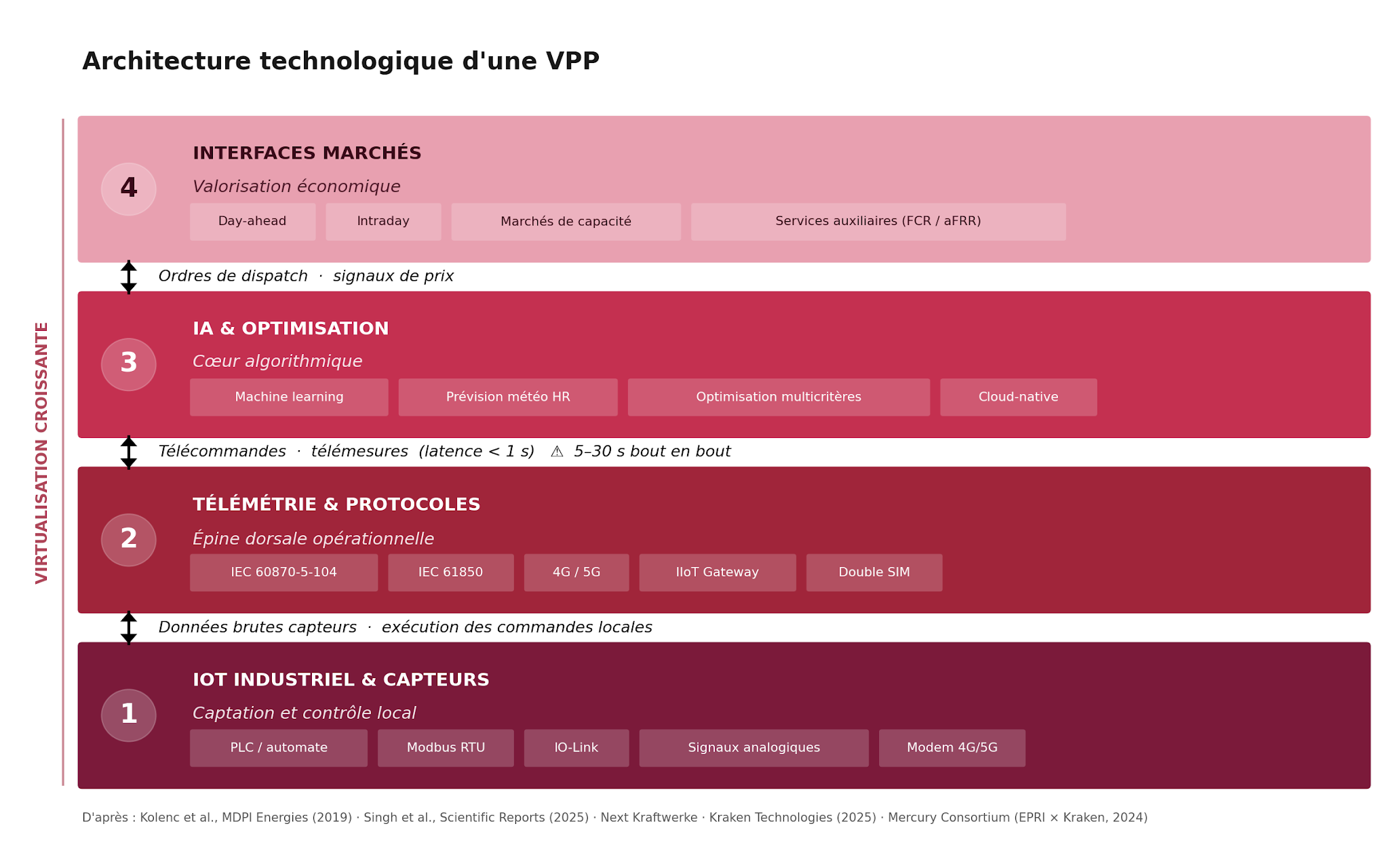
Layer 1. Local capture
At the level of decentralized assets, industrial IoT (internet of things) devices ensure data collection and order execution. The Next Box of Next Kraftwerke illustrates this layer: a programmable controller processes and encrypts the raw data of the equipment and a 4G/5G modem establishes the secure connection to the central system. These boxes must satisfy contradictory constraints (industrial robustness, low consumption, reinforced security) and simultaneously support several proprietary protocols.
Layer 2. Telemetry protocols
Two-way communication between decentralized assets and the central platform is based on several industrial standards. The protocol historically used in SCADA systems and the new standard for object-oriented modeling, constitute the two dominant frameworks with different compromises in terms of flexibility and security. These TCP/IP protocols allow the exchange of remote controls and telemetry with latencies of less than one second. Link redundancy (dual SIM, automatic failover) is becoming critical: a 2 GW VPP losing its connection for 10 minutes during a peak in demand can compromise the balance of the network.
Layer 3. AI and optimization
The technological core lies in multi-criteria optimization algorithms and predictive models using machine learning. The platform Kraken manages over 70 million accounts and processes 15 billion data points daily. Its machine learning modules integrate weather forecasts, demand prediction models, and dynamic price signals to solve a complex combinatorial problem: maximizing aggregator revenues while respecting the individual constraints of asset owners (e.g.: electric vehicle recharged to 80% by 7 a.m.), contractual obligations towards network operators, and the maximization of renewable self-consumption, thereby reducing the “curtailment” (limiting or erasing of production) of surpluses solar and wind turbines.
Layer 4. Interfacing with electrical markets
The economic valuation of a VPP is carried out via APIs connected to electricity exchanges. A VPP typically participates in three types of markets simultaneously: day-ahead and intraday markets, capacity markets, and ancillary services markets (frequency control, rotating reserves). Regulatory integration is a major challenge (auction rules, minimum lot sizes, penalties for unavailability).
Three structural limits
Three obstacles hinder the scalability of VPPs — and therefore their ability to support the rise of renewable energies. The latency between detecting a network event and executing the aggregated response remains 5 to 30 seconds, which is insufficient for some rapid stability services. The heterogeneity of IoT protocols imposes high integration costs: to reduce them, the Mercury Consortium, co-founded by Kraken and EPRI, aims to establish a “Bluetooth of energy” by standardizing communication between equipment and platforms. Finally, cybersecurity is the Achilles heel of distributed systems : VPPs are exposed to attacks by injecting false data that can manipulate price signals and simultaneously destabilize thousands of assets. Deep learning could make it easier to detect these attacks. Removing these three obstacles directly conditions the ability of VPPs to become an operational pillar of renewable integration.
Additional sources: MDPI VPP Architecture 2019 — Mercury Consortium/EPRI — Nature — VPP Cybersecurity 2025