


.png)
The “4 per 1000” initiative, launched during COP21, popularized an appealing idea: increasing global soil carbon stocks by 0.4% annually would be enough to offset all annual fossil fuel emissions. The term “regenerative agriculture,” which will be the subject of a future analysis, has since been presented as a vehicle for this hope, bringing together practices aimed at restoring the vitality of “degraded” soils (Figure 1). Unlike organic farming, it is not subject to any regulatory certification, which creates a level of ambiguity that should not, however, overshadow the genuine agronomic value of these practices.
To understand their impact on the climate, one must first grasp how carbon enters the soil. Plants capture CO2 through photosynthesis and transfer a portion of the carbon to the soil via their roots and residues. Soil microorganisms transform this organic matter into soil organic carbon, or SOC, which exists in two different forms. Particulate carbon (partially decomposed plant fragments) is relatively unstable and can rapidly remineralize (releasing CO2) if disturbed. Mineral-associated carbon, on the other hand, is stabilized through chemical bonding; its residence time can reach several decades, or even millennia.
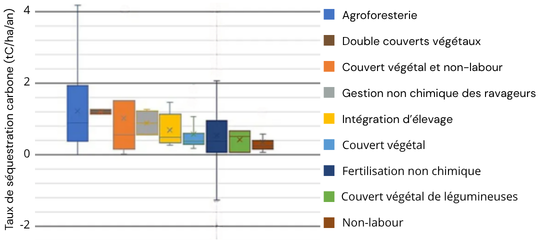
Figure 1 — Soil organic carbon sequestration rates (in tC/ha/year) by regenerative agriculture practice on arable land, based on 264 measurements from the literature, taken at an average depth of 21 cm. Adapted from Villat & Nicholas, 2024.
Three concepts must be distinguished, as confusing them fuels most of the misunderstandings on the subject:
- The annual sequestration flux refers to the amount of additional carbon stored each year (carbon inflow minus carbon outflow) thanks to new practices (Figure 1).
- The additional stock is the accumulation of this flux over the duration of the practices.
- The maximum sink capacity (Figure 2) is the physical limit beyond which a soil can no longer store more stable carbon. This limit is determined primarily by soil texture and cannot be altered by conventional agricultural practices.
Thus, the principle underlying regenerative agriculture consists of promoting an increase in the net carbon sequestration flux by boosting carbon inputs into the soil.
The figure often cited for France (an additional storage potential of 5.69 MtC/year in the 0-30 cm layer on agricultural and forest land) comes from from an INRAE study from 2019. It must be interpreted with these caveats: it is a 30-year simulated average, assuming immediate and total implementation of practices across all technically eligible land. It is neither a constant flow nor a permanent capacity: the sequestration rate is higher when practices are first adopted, while soils are most depleted, then decreases exponentially as the stock approaches a new equilibrium (Figure 2). Accounting for saturation in estimates reduces the potential climate contribution by 53 to 81% compared to constant-rate assumptions.
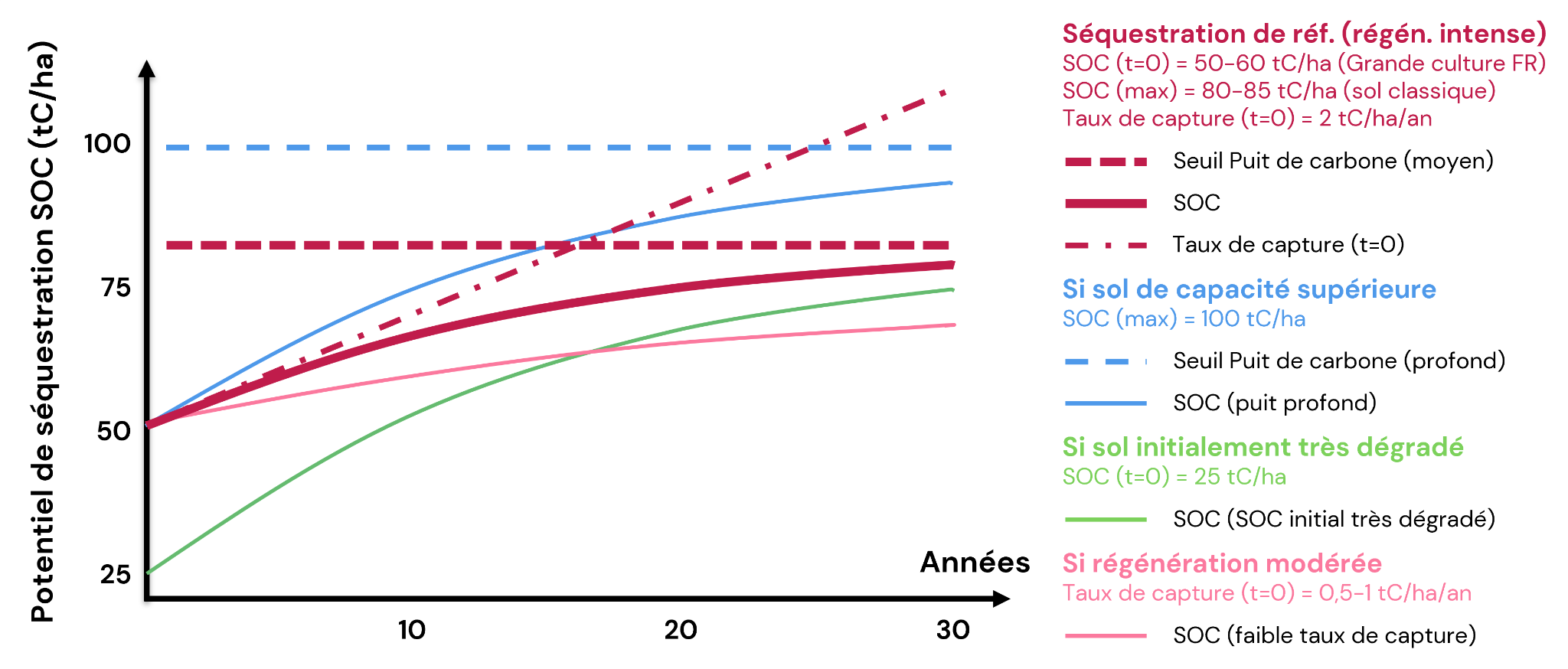
Figure 2 — Schematic evolution of the annual sequestration flow under different assumptions regarding sink capacity, soil degradation levels, and regeneration rates (based on Moinet et al., 2023 and INRAE, 2020).
Agricultural sequestration also has a structural weakness: it is reversible. Carbon accumulated in topsoil layers can be released back into the atmosphere if practices are abandoned, and degradation occurs faster than accumulation.
Regenerative agriculture can be a genuine climate lever, provided its figures are interpreted soberly: it has a time-limited potential, varies spatially depending on soil types, and depends on the long-term maintenance of practices. It could be a valuable supplement to a carbon neutrality strategy, provided that the measurement and verification of stocks ensure its credibility.