


.png)
Robotics encompasses the design, manufacturing, and use of systems capable of perceiving their environment (sensors), making decisions (algorithms or embedded AI), and taking action (actuators). While Renault (via its investment in Wandercraft), Tesla and, most notably, numerous Chinese companies are planning or launching mass production of robots (humanoid or otherwise), each of these three dimensions—designing, manufacturing, and using—consumes materials and energy while generating waste. The environmental footprint of robots has yet to be fully measured.
The market is far from being in its infancy. According to theInternational Federation of Robotics, 542,000 industrial robots were installed worldwide in 2024 (twice as many as in 2014), bringing the total global operational fleet to 4.66 million units. The IFR projects an average annual growth rate of around 7% globally through 2028 (rising from 575,000 installations in 2025 to over 700,000 in 2028), driven largely by China (+10% per year over the same period). In the service sector, logistics and indoor transport are driving the increase, with over 100,000 units sold in 2024 (+14%). This trajectory aligns robotics with other rapidly expanding industrial markets—such as batteries, electric vehicles, and photovoltaics—which are also structurally driven by China. This momentum is highly unevenly distributed: 74% of new industrial deployments are located in Asia, with 54% in China alone.
Some anticipate a significant acceleration in the sector: a recent article hypothesizes that the expectations surrounding AI advancements could lead to a tenfold increase in the production of commercial drones and a hundredfold increase in that of humanoid or quadruped robots by the end of the 2030s.
The production footprint of these systems remains insufficiently documented as an integrated system, despite extensive literature on several of their critical components (magnets, sensors, batteries, carbon fibers). Furthermore, the share of robotics in global rare earth demand is not isolated in available statistics. Its rapid growth could increase its exposure to the supply tensions already observed in other electrified sectors: Chinese export restrictions on rare earths implemented in April 2025 directly impacted Tesla's Optimus robot production lines.
Assessing the climate impact of robotics requires distinguishing between the environmental footprint of the robots themselves and their effect on the emissions of the activities they automate. The available literature focuses on this second dimension. Several studies conducted in China link the adoption of industrial robotics to a decrease in the carbon intensity of certain manufacturing activities, primarily through gains in production efficiency and waste reduction—though no consolidated order of magnitude can be drawn from the available literature, which is limited to the Chinese context. A roadmap proposed by researchers identifies use cases with high potential for emission reduction: inspection and maintenance of wind and solar farms (autonomous robots reducing maintenance costs and downtime, thereby increasing facility availability), precision agriculture, building retrofitting, and environmental monitoring. In France, ADEME funded applied research projects between 2019 and 2023 on robotics in warehouses and urban delivery, the results of which confirm the environmental relevance of robotic and electric solutions for warehousing. However, these applications represent a very small share of the global fleet. Automotive, logistics, and food industry robotics, which account for the majority, are exposed to rebound effects.
Illustration: Annual installations of industrial robots by sector https://ifr.org/img/worldrobotics/Annual_installations_worldwide_by_industries_2024.jpg
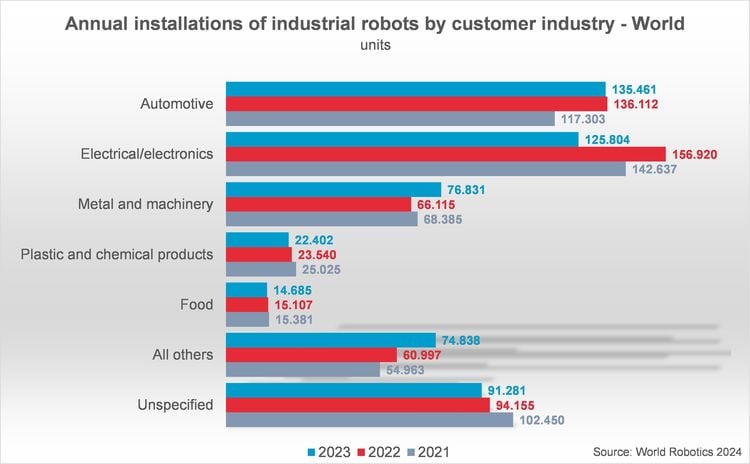
Robotization could contribute to decarbonization through gains in production efficiency, waste reduction, and specific high-leverage use cases in renewable energy or construction. However, this assumes that electricity is low-carbon and that supplies of critical materials are secure. Assessing the contribution of robots requires a comprehensive and harmonized environmental accounting system for the sector, which does not yet exist.