


.png)
On April 22, 2026, Emmanuel Macron inaugurated Imerys' lithium mine in Échassières, a symbol of 150 Major Strategic Projects. A few days later, Émilie Piette, Chair of RTE's Executive Board, reminded us that the average time for connection work is 17 months, adding: "what can take time is mainly the preliminary phase." This deserves a closer look.
Connecting an industrial site to the electricity transmission network (managed by RTE) or the distribution network (managed by Enedis) is a 5-step process for the applicant: exploratory study; technical and financial proposal (TFP); connection agreement; works; commissioning. Once a complete application is submitted, RTE has three months to provide a TFP. However, between the initial request and commissioning, actual lead times range from two to seven years for a high-voltage industrial project, depending on its distance from the grid and upstream reinforcement needs.
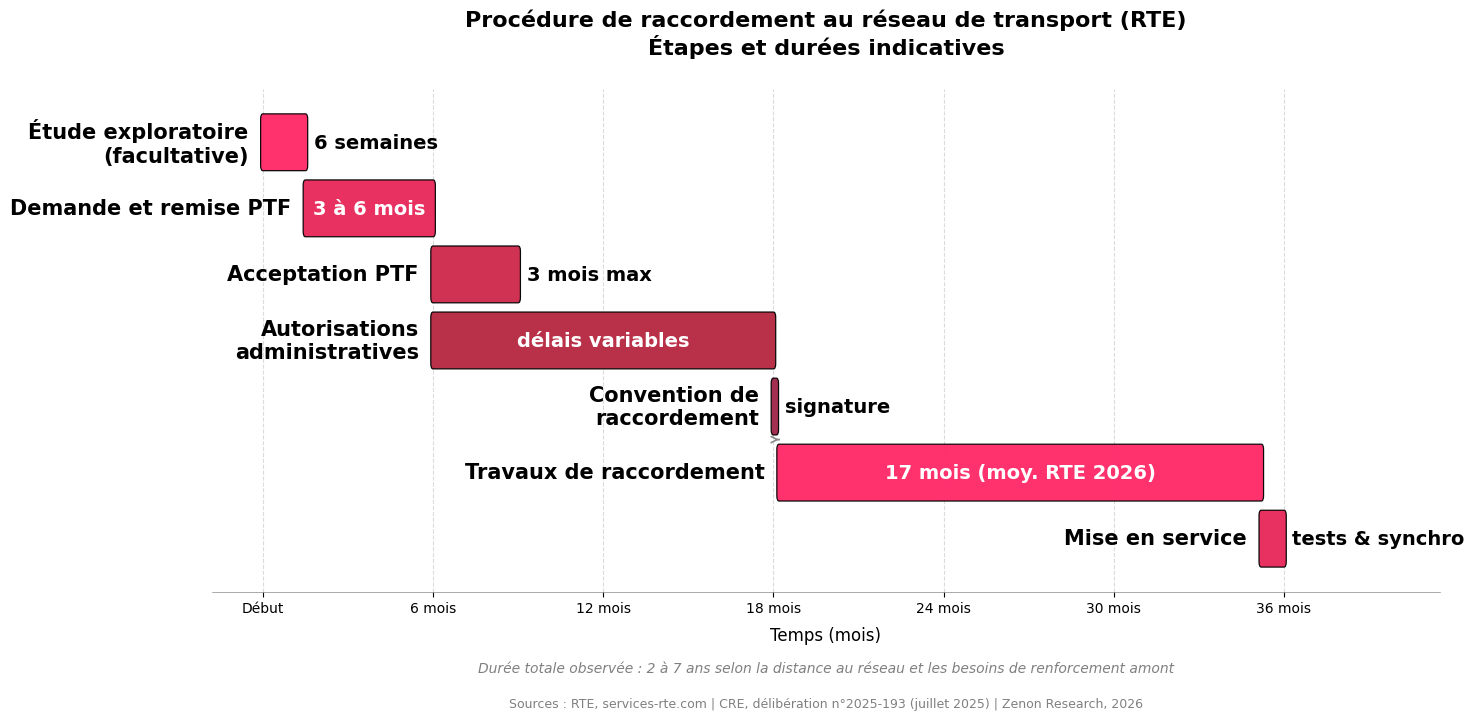
The central paradox is that the grid is rarely physically saturated, but often contractually so: according to the RTE 2025 Ten-Year Network Development Plan, 21 GW of access rights have already been granted for industrial projects, several of which will not materialize at the announced pace. At the European level, a joint report by Beyond Fossil Fuels, E3G, Ember, and IEEFA (May 2025) estimated that 1,700 GW of renewable and hybrid projects were awaiting connection in 16 countries, which is more than three times the capacity needed to meet Europe's 2030 targets. TheIEA (2023) notes that building new grid infrastructure takes five to fifteen years, while a renewable project deploys in one to five years; a structural mismatch that inherently fuels backlogs.
This imbalance between physical capacity and contractually reserved capacity is largely due to the historical "first come, first served" rule, analyzed in a Zenon report on European electricity grids. By allowing grid capacity to be reserved very early on, without project maturity conditions, this principle has led to a "patrimonialization" phenomenon: opportunistic requests aimed at securing a TFP to then sell it to a third party, blocking projects that are genuinely ready for construction. TheFrench Electricity Union calls this phenomenon: "zombie projects." Academic studies on the American case show that the median time between connection request and commissioning has increased from less than two years for projects commissioned between 2000 and 2007 to more than five years for those commissioned in 2023. This degradation is directly correlated with the speculative growth of queues.
The regulatory response is taking shape. In France, the CRE approved in July 2025 a new procedure introducing the "first ready, first served" principle: access rights would now be granted to projects offering the best guarantees of completion. Additionally, there are "connection-ready" industrial zones anticipated by RTE, a temporary connection "tapping into" the 400 kV grid for large industrial projects, dynamic power management to recover dormant capacities, and the possibility for prefects to set, upon RTE's proposal, an order of priority between competing requests in case of projected delays exceeding five years.
These reforms are part of a converging international trend. The United Kingdom adopted in 2024 a system « First Ready and Needed, First Connected » explicitly introducing a criterion of national strategic alignment; the United States reformed its procedure via the Federal Energy Regulatory Commission Order 2023, moving from serial studies to " cluster studies » grouping neighboring projects. The European Commission published a guide in 2025 urging member states to implement " use it or lose it » rules for reserved capacities. For policymakers, the core message is this: grid connection is, to a large extent, a problem of allocation (and therefore of rules) before it is a problem of infrastructure. Accelerating reinforcement work is essential; revising queue rules is more immediately actionable. Both fronts must advance in parallel.