


.png)
CO2 equivalent emissions associated with the production, transport and disposal of plastics are greater today in Europe than those in the steel industry, and twice that of cement. Hence the relevance of the report Plastics in transition by Rémi Grimaud and Robin Girard, published in summer 2024 by Zenon. In particular, it calls into question the centrality of the concept of circularity, which is nevertheless put forward in the subtitle of the report.
Rationalizing the consumption of plastics, rethinking the design of objects, and improving collection and sorting are naturally useful. But, unlike that of metals, the recycling of plastics is a path that does not lead very far. Mechanical, the diversity of chemical compositions greatly limits their possibilities. Chemical, assuming a total decomposition of plastics into basic elements, recycling is more expensive and twice as energy-intensive as production from oil.
Another popular idea is to want to replace oil with biomass, both as an energy source and as a raw material. Thus, the manufacture and the end of life of plastics would lead to the emission of non-fossil carbon, which is therefore offset by the growth of the plants from which it was extracted. Unfortunately, biomass is a limited resource, highly requested by many sectors, undoubtedly essential for decarbonization of air transport. In addition, the priority remains food, and we must take into account the constraints of biodiversity or the availability of fresh water - and in short, of very poor efficiency per hectare of this energy sector.
In the absence of being able to implement this scenario at the necessary scale, other possibilities should be examined. And to do this, remember that CO emissions2Materials linked to plastics account for two-thirds of their manufacture (oil-energy), and for only one third of their disposal (oil-raw material). However, it is possible to electrify the energy of plastic manufacturing, starting with the most important station, that of steam cracking naphtha.
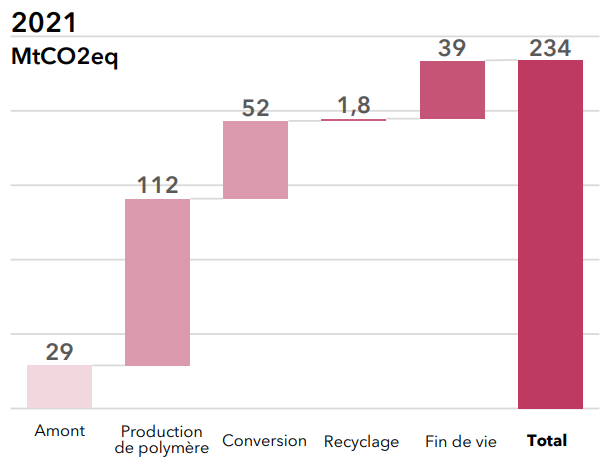
Distribution of emissions from the European plastic sector (Grimaud, R. et al , 2024)
The great chemists are working on it, and a few startups. Among them, Coolbrook, a Finnish company, has developed a Shockwave process generated by a rotor. The electrification of cracking should make it possible to double energy efficiency cracking, and almost suppressing CO emissions2 total with a low-carbon electrical mix such as French or Swedish. In addition, electrical cracking does not generate coke that clogs the ovens, unlike steam cracking. All that would remain would be the emissions upstream from the exploitation of hydrocarbons, and the final emissions from the incineration of plastics at the end of their life. But if we have a lot of renewable energies, do we really need to recover energy from plastics at the end of their life? Hence the idea that is a bit contrary to Grimaud and Girard: to bury them, quite simply, but with adequate protections, without risking the environment, health or biodiversity. It would be a form of carbon storage, very stable, with less risk of leaks than gaseous carbon dioxide...
It is also possible to imagine supplementing insufficient volumes of biomass with green hydrogen. Biomasses are often richer in carbon than in hydrogen, and the manufacture of ethanol (precursor of ethylene) or methanol (precursor of many olefins) generates fatal CO2 emissions (independent of the energy used). To obtain more ethanol or methanol, and reduce these CO2 emissions from the process, one may thus want to add green hydrogen, made with low-carbon electricity.
The problem is that then you have to, per ton of ethanol or methanol, five to six times more energy for this additional production. Of course, it's about electricity, and there are hardly any theoretical limits to green electricity. The idea is not necessarily to be ruled out definitively, but as long as we have not eliminated fossil fuels from electricity production, and electrified, basically, everything we can in buildings, industries and transport, it would be wasting green electricity to choose the path of synthetic methanol. Let's talk about it again in about twenty years.