



Image credit: European Union, Copernicus Sentinel-2 imagery
Osmotic energy refers to the ability to produce electricity from the difference in salinity between fresh water and seawater. Elle is a stable, predictable and energy-dense source. The main source of osmotic energy is naturally located in estuaries, where river waters and seawater meet. On a global scale, this chemical gradient represents a theoretical potential of approximately 1,500 to 2,000 TWh/year, equivalent to the current electricity consumption in the European Union.
Osmotic energy is based on a fundamental phenomenon: if a membrane separates water at a different degree of salinity, spontaneous flows of water or ions occur, in order to balance the concentrations, and can be transformed into mechanical or electrical energy (respectively) depending on the technological sector:
THEdelayed pressure osmosis (PRO — Pressure Retarded Osmosis) is based on the use of a semipermeable membrane separating fresh water and salt water: the natural flow of water to the concentrated solution creates pressure that can drive a turbine and produce electricity. This approach has long been considered to be the most intuitive way to exploit osmotic energy, but it still faces several limitations: still insufficient membrane efficiency, high costs, and biological fouling that rapidly reduces performance. The example of the PRO demonstrator from Statkraft in Tofte, in Norway — a 10 kW pilot finally interrupted — illustrates these technical and economic obstacles. If industrialists like IDE Technologies continue to explore application niches, the PRO still requires major breakups to become competitive on a large scale.
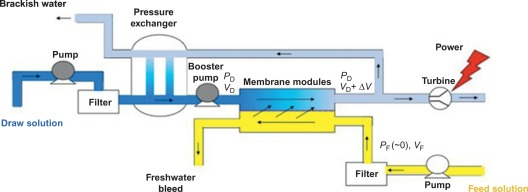
Principle of operation of an osmotic cell at delayed pressure
THEreverse electrodialysis (RED — Reverse Electrodialysis) is based on the alternation of ion exchange membranes - AEM (anionic) and CEM (cationic) - within modular “stacks” where the salinity gradient directly creates an electric current. This architecture promotes modularity, maintenance and integration into existing infrastructures, in particular desalination plants or port networks. International actors suchlike RedStack (Netherlands) have already validated coastal demonstrators, while in France, Sweetch Energy stands out with its INOD® nanofluidic technology and the OPUS-1 demonstrator located on the Rhone estuary. Thanks to better performance prospects, lower mechanical complexity and a good potential for industrial hybridization, RED is now the most mature sector to structure a genuine osmotic energy industry in Europe.
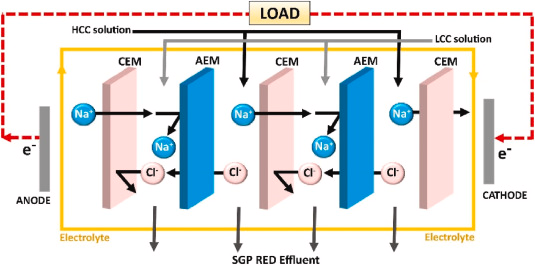
Principle of operation of a reverse electrodialysis module (HCC/LCC: High/Low concentration; SGP: salinity gradient power)
Despite its potential, osmotic energy still faces several challenges. Membrane performance and cost are the main obstacles.. Expected progress in membranes — nanomaterials, graphene, biomimetic structures — could improve performance. La waste management must be carefully planned to avoid local disturbances, and coastal installations require long and expensive permits and environmental studies. Finally, profitability remains to be demonstrated, in the absence of massive industrial deployment. The absence of a regulatory framework or dedicated price signals limits the appetite of investors.
The future of osmotic energy is likely to pass through hybrid projects, combining RED/PRO with solar, wind or desalination - an opportunity because these factories, which consume a lot of energy, emit hypersaline water and are subject to even stronger environmental constraints. Wastewater treatment plants and port infrastructures could accommodate integrated osmotic modules, facilitating their adoption.
Osmotic energy could become a strategic asset for Europe, which has an active industrial fabric in membranes, electrodialysis systems and port infrastructures. With appropriate industrialization, osmotic energy could contribute strategically (up to 1% globally by 2050, but geographically concentrated) to the low-carbon energy mix, because it is complementary to other renewables and capable of providing stable production in an increasingly electric system.