


.png)
In Addis Ababa, the Volkswagen Beetle has been part of the landscape for decades. Imported during the reign of Haile Selassie, it has become the symbol of a capital where cars never die. Since 2024, other models have been colonizing its streets, made in China, as Ethiopia is the first country in the world to ban the import of internal combustion engine vehicles. This surprising electric revolution has a clear explanation.
Ethiopia has an advantage that few countries can claim: 90% of its electricity is hydroelectric, thanks in particular to the Grand Ethiopian Renaissance Dam (5,150 MW) completed in 2025. This energy mix gives the Ethiopian electric vehicle a structurally low carbon footprint. The cost of electricity ($0.01/kWh) is among the lowest in the world: an EV owner spends an average of $4/month to charge it, compared to $27 for gasoline. The equation is attractive for a country whose the oil bill was $3.6 billion in 2023 and which had to benefit from an IMF bailout package of $3.4 billion.
It is precisely this financial pressure, rather than any climate ambition, that precipitated the January 2024 ban, accompanied by an overhaul of automotive taxation: a cumulative tax burden that can exceed 200% for internal combustion vehicles compared to 15% for complete EVs, and 5% for assembly kits. Thus, as of 2024, more than half of all new passenger cars were electric, and the government is announcing over 100,000 EVs on the road, representing approximately 8% of the national fleet.
This shift did not happen without geopolitical influence. Since the end of the Ethiopian Civil War in 1991 and the country's economic development, China has established itself as its primary partner : 70% of new roads, the Addis Ababa light rail, the continent's first transnational electrified railway, most industrial parks were all built or financed by Chinese companies. Between 2000 and 2018, Beijing lent $13.7 billion to Addis Ababa. In this context, the invitation extended in 2024 to Chinese manufacturers to explore local assembly is hardly surprising. In 2025, Ethiopia thus absorbed approximately one-third of the 44,358 EVs exported by China to Africa.
Beyond being an emerging market for China, and its mining appeal, Ethiopia could become Africa's manufacturing hub by replicating the model of special economic zones (SEZs) Chinese (figure), taking advantage of low wages and cheap energy.
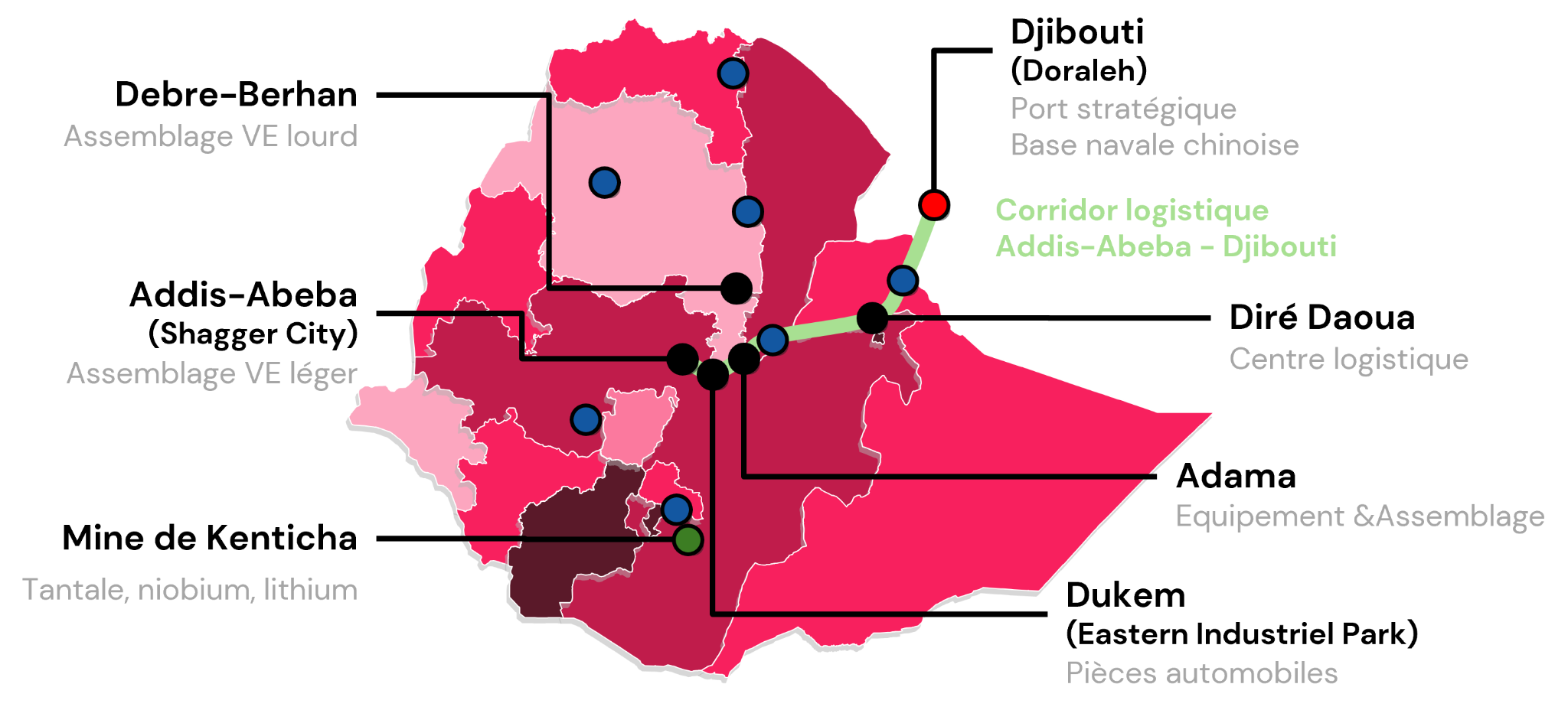
Figure – SEZs involved in the automotive industry (in black) in Ethiopia; other SEZs (in blue) are primarily dedicated to textiles and agribusiness; a lithium mining complex is strategic for batteries (in green) – other small mines, for example copper, are bolstering EV production – note that announcements regarding cobalt reserves do not appear to be well-founded; the majority of incoming and outgoing flows pass through Djibouti (in red), where China has had a presence since the Darfur war. (Zenon Research, 2026)
Official announcements, however, call for caution. Estimates of the fleet vary by a factor of four: from 30,000 to 120,000 units. On the ground, as in the rest of Africa, the obstacles are tangible: less than half of Ethiopians have access to electricity, the grid suffers from frequent outages, and the country has only about a hundred public charging stations for an estimated need of 2,300. Spare parts are almost impossible to find: some owners repair their vehicles using YouTube tutorials, faced with manuals written in Mandarin. A BYD Seagull sells for $23,000 in a country where the per capita income barely exceeds $1,000.
Ethiopia illustrates both the potential and the limitations of a default electric transition in the Global South: it is real when macroeconomic constraints align with a structural energy advantage, exacerbated by the Strait of Hormuz crisis, but fragile without charging infrastructure, a local maintenance industry, and given an almost total technological and financial dependence on a single partner. The ambition to leverage Ethiopian lithium resources to produce batteries locally remains just a project. The fundamental question is raised: will Ethiopia become Africa's first electric manufacturing hub, or will it remain a strategic market for China? One thing is certain for the new flower : the Beetles will be Asian.