


By Rémi Noyon, Author of the book “The big turnaround, how geoengineering is infiltrating climate policies”
Solar geoengineering - also called solar radiation management - refers to a set of controversial techniques aimed at artificially cooling the planet to slow the effects of global warming.
The main process envisaged is the injection of aerosols into the stratosphere. Sulfur dioxide diffused at high altitude oxidizes to form a sulfuric acid plume, which allows, through the appearance of tiny droplets, to reflect a small fraction of incoming solar radiation. This idea is directly inspired by what we observe when volcanoes wake up. The gas and smoke columns Train a drop in temperatures, as was the case after the eruption of Pinatubo in 1991.
Lightening marine clouds is the second technique studied. It consists in diffusing salt crystals at low altitude in order to increase the condensation nuclei in the cloud and to increase their albedo. There are other projects, such as The thinning of cirrus clouds, but they are the subject of only a handful of publications.
Heir to the Promethean spirit of the Cold War, and its desire to control nature, geoengineering Has mutated to be defended by Earth system scientists, who fear the passage of “tipping points”, such as the weakening of marine currents in the Atlantic. The sun veil Is then seen as the only way to avoid such worst-case scenarios.
Solar geoengineering remains criticized for numerous reasons, including:
- The terminal shock: if a solar geoengineering program were to be interrupted abruptly, without the CO₂ concentration in the atmosphere having dropped, temperatures would rise rapidly.
- Unexpected effects on the Earth system: the Sun's energy is at the origin of most major planetary cycles, such as the water cycle. Modulating it would have cascading effects, for example on rainfall, which are difficult to anticipate.
- The exacerbation of conflicts: most models are idealized, that is to say, we imagine a deployment without conflicts. In the real world, geoengineering could create tensions, for example if a country feels harmed by a weakening of the monsoons.
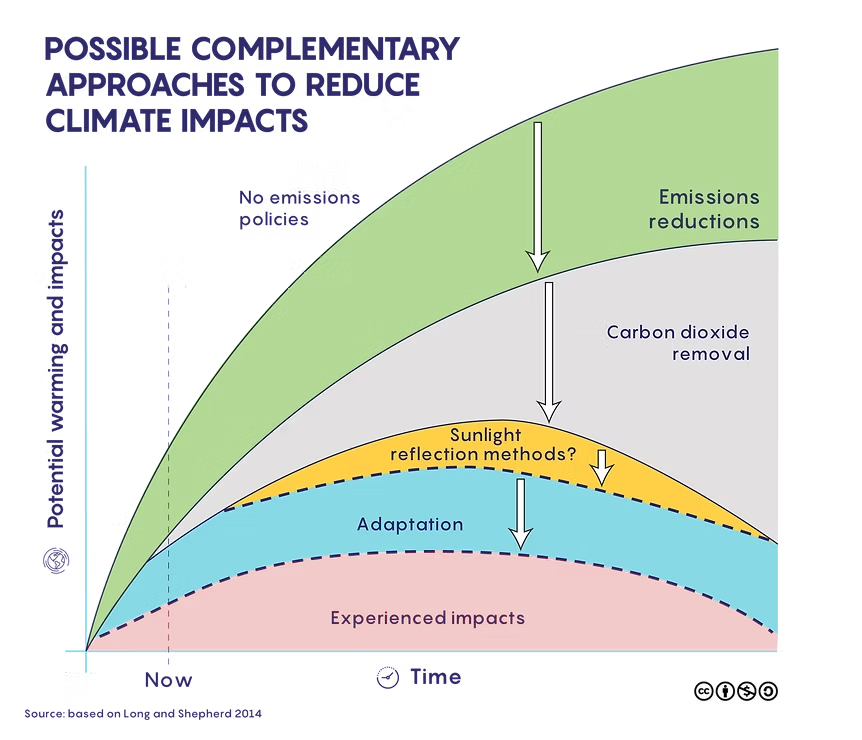
- The pursuit of business-as-usual: in the minds of its defenders, solar geoengineering is designed as a way to limit the extent of the overshoot, the time to deploy low-carbon technologies and the means to remove atmospheric CO₂; this is what we call the napkin diagram named after a drawing carried out in 2010 at the Asilomar Conference. On the one hand, this presupposes that we develop ways to eliminate atmospheric CO₂, which is far from assured; on the other hand, this damping of the effects of global warming still requires us to get out of fossil emissions. For critics, it's a way to prolong procrastination by making the equation even more complex.
In practice, for the moment, most of the research around solar geoengineering consists in numerical simulations, in particular on Earth System Models. External research have been conducted in Australia, above the Great Barrier Reef, for the clarification of marine clouds. For injecting aerosols into the stratosphere, the advisability of carrying out tests remains highly debated, between those who believe that this would improve climate models and those who believe that this is a slippery slope towards deployment.
In 2025, the arrival of private actors - like the start-up Stardust - raising venture capital funds to develop a complete device for injecting aerosols into the stratosphere has aroused lively debates: for scientists, such research must escape to the logic of profit so that the possible choice of a deployment is not guided by the wrong reasons. The other big question that remains open is that of governance: would the coordination of such a program, which would affect all living beings on Earth, be possible in a world that is becoming less and less cooperative?