


The ocean covers 71% of the Earth's surface. Its movements represent a massive amount of energy. Yet, wave energy—or wave power—remains absent from the global energy mix. According to estimates, the theoretical global potential for wave energy is between 2,000 and 8,000 TWh/year, which is more than 30 times France's electricity consumption. Europe could produce 150 TWh/year of wave energy, and mainland France 40 TWh/year, primarily along the Atlantic coast. The global wave and tidal energy market, valued at $1.82 billion in 2025, could reach $4 billion by 2035 (+9%/year).
To capture this energy, several families of technologies have been developed, all based on a common principle: using the movement of waves, swells, or currents to compress a hydraulic fluid, drive a turbine, and thereby generate electricity. Some examples include: wave clapper, “floating nodes”, articulated floating chains (attenuators). None of these technologies have yet reached the commercial stage.
Its capacity factor (the ratio of energy produced to maximum theoretical energy) could reach 30 to 50%, which is higher than onshore wind (21.4%) and comparable to offshore wind (38.8%). Despite this strong production potential and the predictability of available power one to two days in advance, its Levelized Cost of Energy (LCOE, Levelized Cost of Energy) in the EU remains prohibitive due to its stage of maturity (see Figure 1). The goal set by the European Strategic Energy Technology Plan (European Strategic Energy Technology Plan or SET-Plan) to reach €150/MWh by 2030 and €100/MWh by 2035 requires an unprecedented industrial effort. There are numerous technical challenges: corrosion in marine environments, anchoring reliability, offshore electrical grid connection, and costly maintenance.
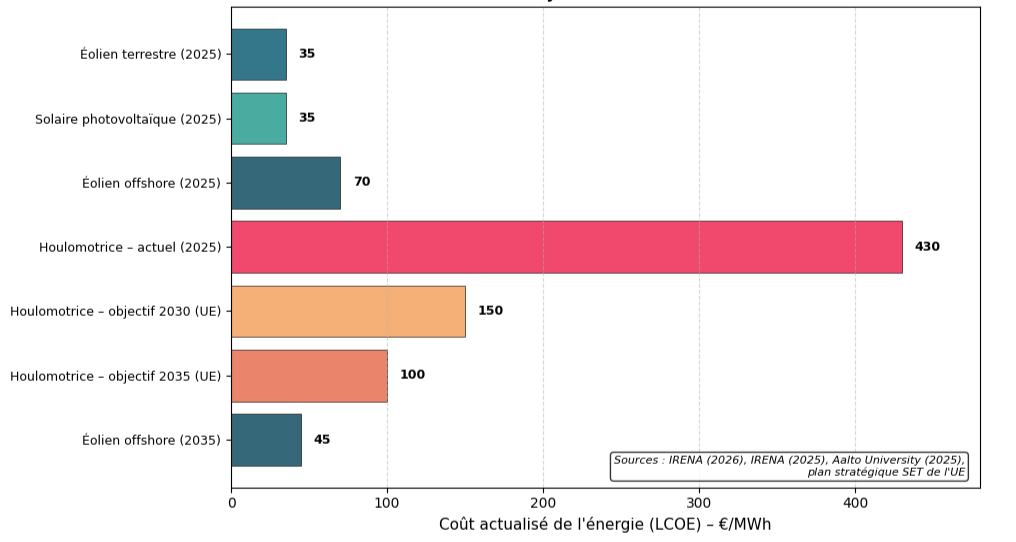
Fig. LCOE comparison: wave energy versus mature renewable sectors and industrial targets
Two pilot projects clearly illustrate how the sector is attempting to overcome these obstacles. One remains close to the coast to facilitate grid connection, while the other operates off-grid by consuming the energy at sea. On land, the Port of Los Angeles inaugurated the first pilot project for a wave power plant in the United States in 2025, led by Eco Wave Power using wave clappers and feeding directly into the grid. For maintenance in marine environments, the company has entered into a partnership with BladeRanger : following a successful demonstration in Jaffa, autonomous drones will clean and inspect the floats to reduce operating costs (historically 4% of annual investments). On the maritime side, the American startup Panthalassa has completed a record-breaking fundraising round. Its floating nodes use the motion of the swell to create a high-pressure jet in a vertical tube, which feeds a pressurized reservoir. The pressurized water then drives a turbine and generator, based on the principle of a hydroelectric dam. The electricity produced directly powers data centers cooled by seawater, allowing the energy to be used on-site and avoiding costly grid connections. However, the company also plans to produce green hydrogen on board via electrolysis, then transport it to shore using autonomous vessels. This dual strategy would completely eliminate connection cables and could, according to Panthalassa, become the most competitive solution in the electricity market.
Recent advances show real momentum, but no business model has yet proven itself. Without stable price signals, wave energy risks remaining an eternal promise. The challenge is also environmental and social: landscape acceptability, as well as impacts on ecosystems, fishing, and maritime transport, must be assessed without complacency. At a time when energy security and decarbonization require diversifying renewable sources, can we consider riding the wave of wave energy?