


.png)
Heavy industry consumes approximately 30% of the world's final energy, with the majority in the form of high-temperature heat. A portion of this energy is currently wasted: furnace fumes, process gases, and radiating walls release waste heat often exceeding 400°C. High-Temperature Heat Pumping (HTHP) could be a solution for recovering this industrial heat in a closed loop, which conventional recuperators cannot reintroduce into the process. In the longer term, modular nuclear reactors like SMRs (outlet temperatures ~ 300°C) and high-temperature AMRs (>500°C) could provide low-carbon heat to industrial processes, and target higher temperature applications thanks to HTHP.
Vapor compression heat pumps are limited to 200-250°C, due to the thermal limits of refrigerants and lubricants. Beyond this, the coefficient of performance (COP, the ratio of heat supplied to electrical energy consumed) significantly decreases and is no longer cost-effective. To overcome this barrier, several technological avenues are being explored.
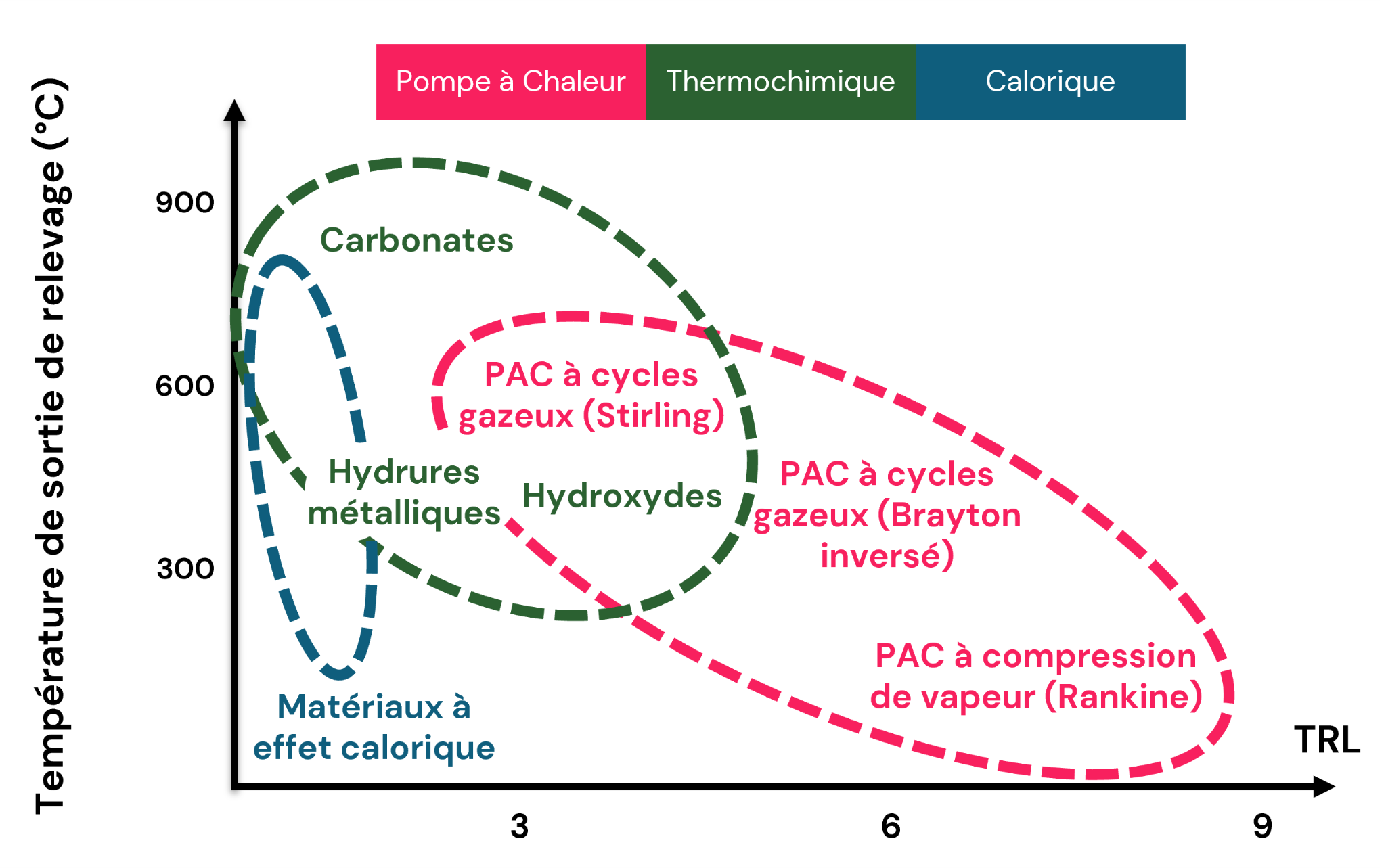
Figure - Main technological pathways for high-temperature industrial heat recovery of ~100°C (based on data from Yoo et al., 2023)
The first, like heat pumps, utilizes the inverse Brayton cycle but by replacing the refrigerant fluid with an inert gas (air, helium, supercritical CO2) which does not change state (TRL 4-6). This overcomes the chemical limitations of refrigerants. This cycle becomes more efficient than vapor compression from 215°C outlet temperature and can, theoretically, reach 1,000°C. Its similarities with high-temperature gas AMR, which can use helium as a heat transfer fluid, would make it compatible with nuclear-industrial coupling projects.
The second approach is based on reversible chemical reactions (discussed in our analysis of thermochemical storage): dehydration and rehydration of metal oxides such as calcium oxide, or carbonation cycles (TRL 3-5). The advantage of these compounds is their ability to release heat at a higher temperature than that at which they were charged. Outlet temperatures between 500°C and 800°C would thus be achievable from sources at 300-400°C. This purely thermal temperature upgrading would enable the recovery of waste heat without a powerful electrical connection.
The third approach, currently in research, involves caloric effect materials (electrocaloric, magnetocaloric) which change temperature under the influence of an external field, without fluid or moving parts (TRL 2-3). The first simulation of such a heat pump operating between 360°C and 420°C achieved a simulated COP of 2.7. These technologies ultimately aim for temperatures up to 1,300°C.
The advantage of these temperature upgrading methods is having a COP greater than 1, which means they are more efficient than direct electric heating (resistive, induction), whose electricity-to-heat conversion (COP) is capped at 1. This thermodynamic advantage diminishes as the outlet temperature rises and the temperature differences to be overcome widen. For an upgrade from 300-400°C to temperatures above 600-800°C, the COP of available technologies would thus barely 1.5.
At these levels, direct electric heatingDirect electric heating, which is simpler and more mature (TRL 7-9) and already deployed industrially, remains competitive, not in energy efficiency, but in cost, reliability, and deployment timeline. The relevance of RTHT compared to direct heating is therefore a question of industrial context: electricity availability, kWh cost, the existence of an exploitable waste heat source, and the magnitude of the temperature difference to be overcome.