


.png)
The energy transition involves managing the time lags between energy production and consumption. This is particularly true for heat, which accounts for approximately 50% of global final energy demand. Thermal storage is therefore a key solution for utilizing renewable heat, industrial waste heat, or surplus electricity converted into heat.
Among the different approaches — sensible storage, latent or thermochemical — the former is currently the technology that is the most mature. Energy is stored by raising the temperature of a material, then released when it cools down. The amount of heat stored depends on the material's thermal capacity, and its nature defines the three main families of sensible storage.
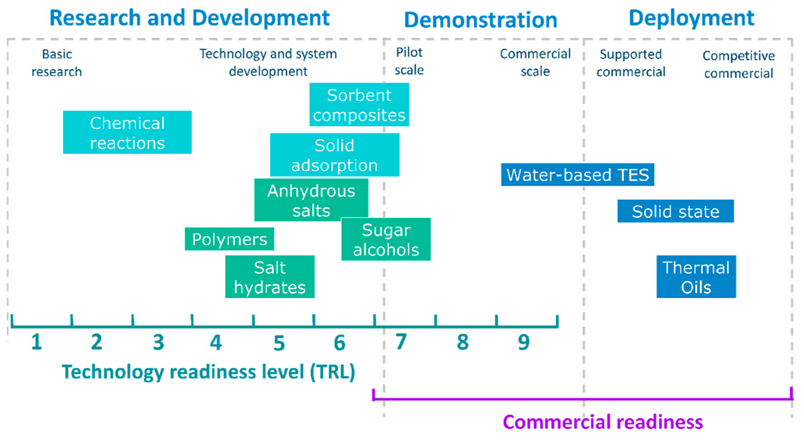
Figure 1 – Maturity level of industrial heat storage technologies (100-300°C): sensible (in blue), latent (in green), and thermochemical (in turquoise) (Palacios et al., 2025)
Water storage is the most common solution. This is the principle behind domestic hot water tanks, and on a large scale, hot water reservoirs can reach tens of thousands of cubic meters, potentially allowing for the storage of summer heat for winter heating of entire districts. However, their energy density, which necessitates large storage volumes, is a significant limitation.
For high-temperature applications, heat transfer fluids are used, particularly synthetic thermal oils. They are especially employed in solar power plants concentrating and allow for heat storage at around 500 °C, which enables electricity production a few hours after sunset. Their limitations include issues with corrosion, chemical stability, and cost.
Heat storage in solid materials (sand, rocks, gravel, refractory concrete, or ceramics) offers the advantage of material robustness and low cost, as they are often locally available. Operating temperatures can exceed 1000 °C in certain industrial applications. The challenges primarily concern heat transfer and mechanical stresses related to heating and cooling cycles.
One of the major advantages of this form of thermal storage for industry is its cost per unit of energy (lower than that of batteries) and its modularity. The materials used are often inexpensive and abundant. This characteristic makes it a particularly attractive solution for long-duration storage, where batteries become costly.
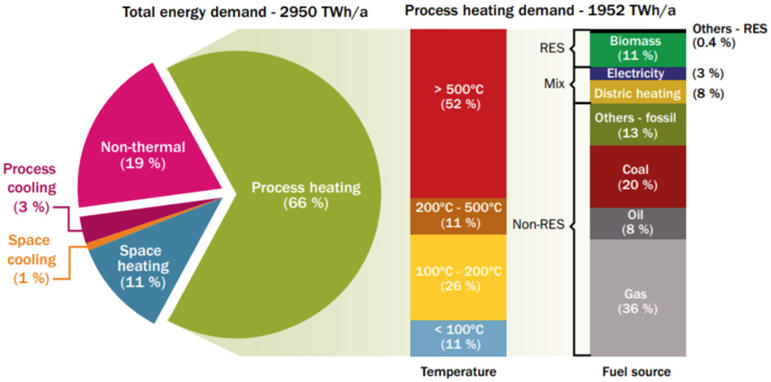
Figure 2 – European industrial energy demand by application, process temperature, and energy source (Palacios et al., 2025)
A large portion of industrial energy consumption relates to process heat (100 to 1000 °C). Thermal storage notably allows for the recovery of waste heat, smoothing energy consumption, and converting surplus renewable electricity into heat. In this regard, it would be key to integrating high shares of variable renewable energies into energy systems. This approach could significantly contribute to reducing emissions in steelmaking, cement production, agri-food, and chemicals.
France has several advantages: an expanding heat network, significant industrial heat recovery potential, and favorable public policies (ADEME heat fund). The main incentive for their deployment will be economic: energy that is more expensive and more volatile is a decisive factor, and we are on the verge of profitability.