


.png)
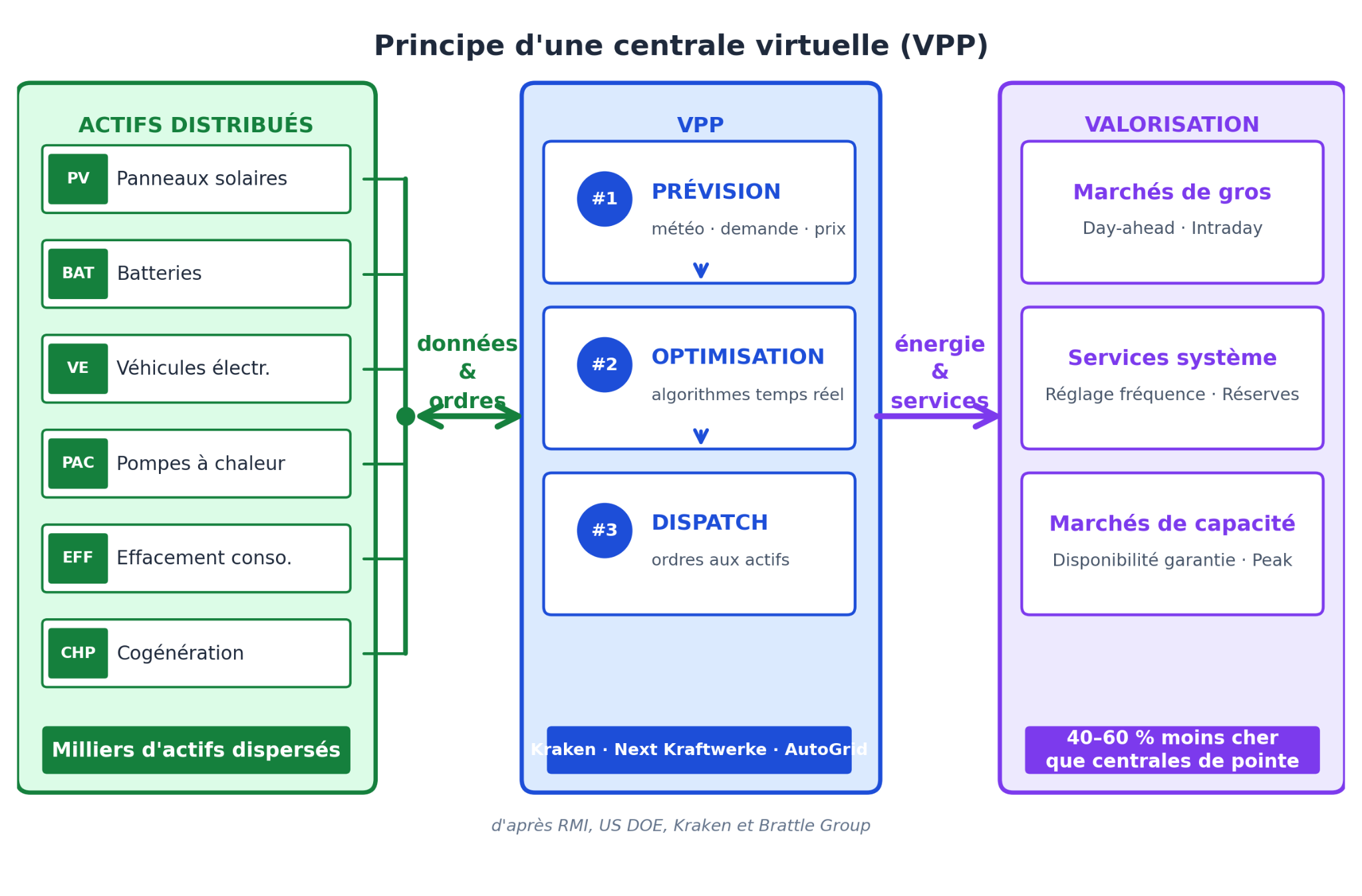
A virtual power plant (VPP) is a network of decentralized energy resources (solar panels, home batteries, electric vehicles, heat pumps...) aggregated and coordinated by a software platform to function as a single power plant.
Unlike traditional power plants, which concentrate their production in a single location, VPPs digitally orchestrate thousands of geographically dispersed assets.
The term “virtual” refers to this orchestration: the equipment is physical and localized, but its management is centralized via real-time control systems. An aggregator, the operator of a VPP, collects production and consumption data for each connected asset, optimizes their operation based on price signals, network constraints, and forecasts, and then sends the corresponding control commands.
VPPs respond to a structural challenge of the energy transition: massively integrate intermittent renewable energies while maintaining the instantaneous balance of the electrical network. According to Brattle Group, VPPs are a 40 to 60% cheaper alternative to advanced thermal power plants to manage peak demand. The Rocky Mountain Institute estimates that in the United States, VPPs could avoid several tens of millions of tons of CO₂ by 2035.
In France, RTE integrates diffuse erasure into its adjustment mechanisms, in the same way as electricity production, while Energy Regulatory Commission (CRE) specified the aggregation conditions for access to capacity markets. French regional pilot projects such as SMILE or SYNAPSE demonstrate the technical feasibility of orchestration at the regional level.
In concrete terms, a VPP can:
- eliminate peak consumption (peak shaving) by delaying certain loads over time (EV charging, heating);
- provide upward or downward flexibility in seconds to stabilize network frequency;
- avoid or postpone major investments in electricity transmission and distribution infrastructures;
- economically value decentralized assets for their owners through flexible remuneration.
The platform Kraken manages more than 500,000 domestic equipment representing 2 GW of flexible capacity. Its system automates the charging of EVs and the operation of PACs during periods of high renewable production and low demand, generating up to €200 million in savings for participating consumers.
However, the benefits of VPPs remain dependent on market rules, the stability of tariff signals and the ability of regulators to recognize and reward flexibility distributed in a predictable manner.
Scaling up VPPs faces several obstacles. Access to electricity markets remains complex for residential resources with a small unit capacity, as auction qualification rules and telemetry requirements have been historically calibrated for power plants of several tens of MW. Customer acquisition and equipment costs are also an economic drag for aggregators, while revenue uncertainty complicates the construction of viable business models.
Finally, the real-time coordination of hundreds of thousands of heterogeneous assets requires significant investments in telecommunications infrastructure, forecasting algorithms, and cybersecurity devices. In the coming years, the ability of regulators, network operators and aggregators to align economic incentives, consumer protection and safety requirements will be key to making virtual power plants a credible pillar of low-carbon electricity systems.
A second VPP decryption will analyze critical technological building blocks — IoT protocols, stochastic optimization algorithms, edge-cloud communication architectures — which condition the transition of VPPs from local demonstrators to the systemic infrastructure of the European electrical network.