


The National Climate Change Adaptation Plan (PNACC-3) aims to"avoid maladaptation". In its 2026 annual report, the High Council on Climate (HCC) argues, however, that current adaptation efforts "favor incremental and technological responses" that "address certain short-term impacts while exacerbating or shifting risks to other stakeholders," and that French plans "do not avoid maladaptation." Between the promise and the verdict, what safeguards against maladaptation are being put in place by the plan?
The IPCC provides a broad definition of maladaptation, which also covers adaptation that fails. Scientific literature proposes a framework of four questions: regarding the decision-making process, the plurality of causes, time scales, and spatial scales.
When put to this test, the PNACC-3 proves to be unevenly equipped:
- Regarding the process, the plan is scheduled to be revised every five years. Measure 26 announces impact indicators for biodiversity, health, and natural resources, "in order to correct trajectories if major or irreversible impacts are observed." This is an a posteriori control: the text sets neither a threshold nor an authority responsible for triggering corrective action.
- Regarding multiple causes, safeguards exist on a measure-by-measure basis. A comparative carbon, energy, and water study of gray and green solutions (measure 20); the "do no harm" principle applied to business subsidies (measure 34), for Ademe, France 2030, and Bpifrance programs only; and a mission on the cumulative effects of desalination (measure 21). However, no common framework connects these building blocks.
- Regarding time scales, the PNACC-3 is better adapted. Cost-benefit analyses must incorporate the reference warming trajectory (measure 3), standards are currently being revised (measure 24), and environmental assessment is aligned with this trajectory (measure 40). This is the subject of our analysis (1/2): designing for the climate that will be, not the one that was. But proper calibration is not enough to avoid irreversible investments. The word "lock-in" only appears in the plan in relation to bus windows, and "irreversible" only as a reason for ex-post correction.
- Regarding spatial scales, nothing is yet in place to assess the shifting of risk to other territories or other stakeholders. "Vulnerability transfer" is included in the definition of action 5, but it has no identifiable operational translation. A guide on maladaptation, which was supposed to provide one, has been promised since 2025.
The plan therefore protects itself against calibration errors and environmental damage; it is less clear regarding lock-in and risk shifting, the two effects that the HCC highlights. These are also the ones that the Court of Audit notes regarding artificial snow, which can "tend toward maladaptation" and create a "path dependency," and which we also see with air conditioning, which protects a building by offloading its heat and electricity demand onto its neighbors and the grid.
Adapting quickly requires precise calibration. Adapting effectively also requires knowing what is at stake, and for whom.
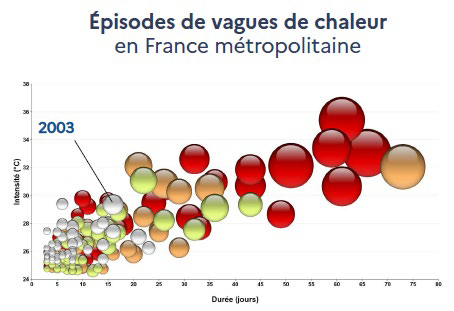
Fig. Intensity and duration of observed / expected heatwaves. The size of the bubbles indicates the severity of the heatwave: it is proportional to the cumulative heat during the episode.Source: PNACC-3