



On October 27, 2026, the European Commission proposed a Climate Resilience Framework with a common warming trajectory: +1.5°C by 2030, +2°C by 2050, and +3°C by 2100 globally. France had suggested the principle in June 2023 and wanted to model it after its own, the TRACC (Reference Trajectory for Climate Change Adaptation), where the same levels result in +4°C for mainland France by 2100. What climate should we be designing assets for that will still be in service by then?
The National Climate Change Adaptation Plan PNACC-3 assumes that by 2030, all public policies and their technical standards will be brought into compliance with a +4°C trajectory by 2100. These standards are currently based, the plan specifies, on local climatology observed "ideally over a thirty-year period" (p. 179). In the meantime, assets are being ordered with lifespans that may exceed 30 years.
Eurostar offers a recent example of this. The company had ordered 50 trainsets from Alstom, designed to operate in temperatures up to 45°C. In an interview with the Financial Times on July 10, 2026, its CEO, Gwendoline Cazenave, explained that the succession of heatwaves in early summer 2026 led to the decision to opt for a 55°C specification instead.
Several timeframes overlap: for Eurostar, the trains are designed to last thirty years and run until the 2060s; for PNACC-3, new railway equipment is designed for "at least forty years"; while the cost-benefit analyses that determine funding from the Barnier Fund are "generally established over fifty years" and must now incorporate the evolution of hazards according to the TRACC.
An asset specified in 2026 is therefore living under the climate of 2050, or even 2070. This mechanism is not unique to rail: in Nouvelle-Aquitaine, 16 reservoirs had been sized based on 2000-2011 weather conditions; their permits were canceled by the Poitiers Administrative Court in October 2023, as the structures were oversized relative to the current and future climate. A case that the European Court of Auditors cites as an example of maladaptation.
Data from the summer of 2026 highlights the scale of the gap. According to Météo-France, it was the hottest summer since 1900, with 53 days of heatwaves compared to 33 in 2022, and 45% of the territory reaching 40°C or more at least once. A single summer is not a trajectory.
The updating of standards is underway. Measure 24 of PNACC-3 provides for an overview of ongoing work, a list of criteria to be applied to each revision, and a gradual adaptation of all reference frameworks, noting that a standardization request from the European Commission aims to revise 350 standards by the end of 2026. AFNOR has provided the ministry with a tool to prioritize those that need to evolve, which was deployed in 2026 (June 2026 progress report). What temperature are we currently using to design a bridge, a warehouse, or a data center? The High Council on Climate recommends adding a more severe warming scenario to test the robustness of these measures.
Choosing a parameter comes at a cost. Designing for 55°C implies more air conditioning, and therefore higher consumption—a trade-off that the PNACC-3 itself notes regarding rolling stock. Adaptation commits an asset for its entire lifespan, along with the associated emissions and energy use.
The question of monitoring the impacts of these adaptations is therefore becoming crucial. It will be the subject of our next analysis.
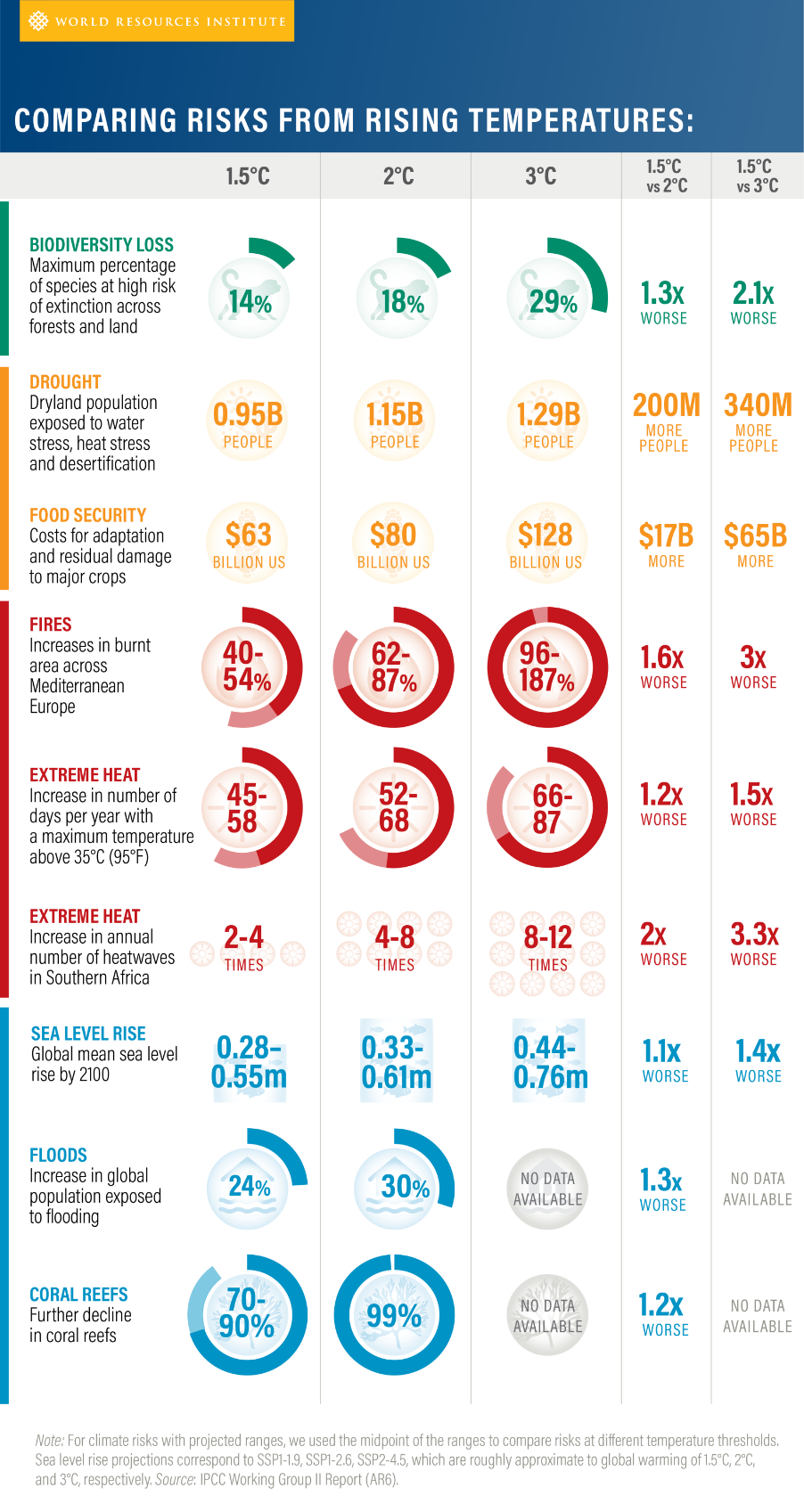
Figure - Adaptation: comparing risks associated with rising temperatures (IPCC AR6)